
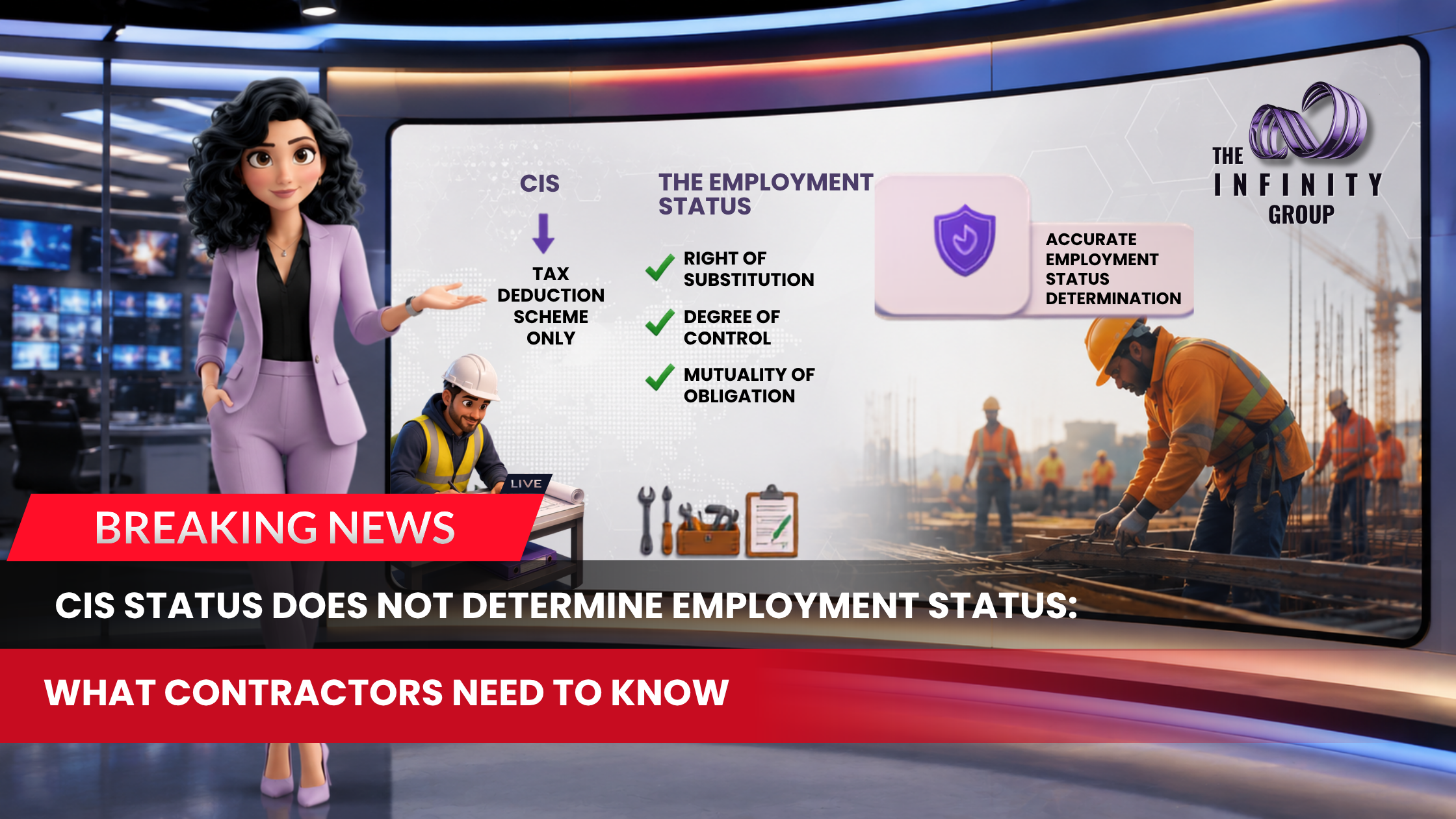
The Construction Industry Scheme (CIS) is a well-established part of the tax compliance framework. Contractors are responsible for verifying subcontractors, applying CIS deductions where required and reporting payments to HM Revenue & Customs (HMRC). However, a common misconception is that an individual who is registered under CIS, or receives payments subject to CIS deductions, must automatically be self-employed.
This is not the case. CIS determines how certain construction payments are treated for tax purposes. It does not determine employment status. Employment status must be assessed separately by considering the facts and circumstances of the engagement and the reality of the working relationship.
For construction businesses, understanding this distinction is essential. Individuals engaged as CIS subcontractors may nevertheless be found to have worker or employee status where the nature of the engagement supports that conclusion. As a result, contractors should ensure that employment status assessments are not based solely on CIS treatment.
What Is the Construction Industry Scheme (CIS)?
The Construction Industry Scheme is a tax regime that applies to certain payments made by contractors to subcontractors carrying out construction operations.
Under the scheme, contractors may be required to make deductions from subcontractor payments and pay those deductions to HMRC. The deductions are generally treated as advance payments towards the subcontractor’s Income Tax and National Insurance liabilities.
The purpose of CIS is to establish how construction payments are administered for tax purposes. It is not designed to determine whether an individual is self-employed, a worker or an employee. That assessment must be made separately by considering the nature of the engagement.
What Is Employment Status?
Employment status determines the legal relationship between an engager and the individual carrying out the work. It affects the rights available to the individual and the obligations placed upon the organisation engaging them.
The principal categories are:
- Employee
- Worker
- Self-employed contractor
Within the construction industry, attention is often focused on the distinction between employment and self-employment. However, worker status is equally important. Workers may not have all the rights afforded to employees, but they can still benefit from a number of statutory protections.
These may include:
- Statutory paid annual leave
- National Minimum Wage protection
- Rest breaks and other Working Time Regulations protections
- Protection against unlawful deductions from wages
Whistleblowing protection; and
- Protection from unlawful discrimination.
For this reason, businesses should not assume that CIS status alone determines an individual’s legal position.
Why CIS and Employment Status Are Separate Considerations
A common misunderstanding is that an individual paid under CIS must automatically be regarded as self-employed.
HMRC guidance makes clear that this approach is incorrect. The fact that an individual is registered under CIS, or that deductions are being made under the scheme, does not determine employment status. Instead, employment status depends on the terms of the engagement and the reality of the working relationship
In practice, CIS and employment status address different questions:
CIS asks:
How should payments for construction work be treated for tax purposes?
Employment status asks:
What is the legal nature of the relationship between the parties?
These are separate considerations and should be assessed independently.
Factors Relevant to an Employment Status Assessment
There is no single test that determines employment status. HMRC, courts and tribunals consider the overall picture when assessing the nature of an engagement.
Control
One of the most significant factors is the degree of control exercised by the engager.
Relevant considerations may include:
- Who determines how the work is performed?
- Who decides the working hours?
- Who specifies where the work must be carried out?
Greater levels of control may indicate worker or employee status.
Personal Service
A requirement for the individual to provide services personally is often an important consideration.
Where the individual is expected to carry out the work themselves and cannot realistically provide an alternative, this may influence the status assessment.
Right of Substitution
A genuine and practical right of substitution is often associated with self-employment.
However, substitution clauses that exist only within contractual documentation and are not capable of being exercised in practice are unlikely to carry significant weight.
Mutuality of Obligation
Another important consideration is whether:
The engager is obliged to provide work; and
- The individual is obliged to accept that work.
The degree of ongoing obligation between the parties can be relevant when determining status.
Commercial Risk
Individuals operating a business on their own account typically assume a level of commercial risk.
Examples may include:
- Rectifying defective work at their own expense
- Quoting for projects
- Investing in equipment
- Managing profit and loss associated with the engagement.
Provision of Equipment
Consideration may also be given to who provides tools, equipment and materials.
Although not determinative on its own, this can assist in assessing whether an individual is operating independently as a business undertaking.
Integration into the Business
The extent to which an individual is integrated into the engager’s organisation may also be relevant.
For example, an individual who works exclusively for one contractor, follows the same internal procedures as employees and is managed in the same way as the employed workforce may present a higher employment status risk.
Common Employment Status Risks in the Construction Sector
Employment status issues frequently arise where subcontractor engagements evolve over time.
An engagement may begin as a short-term subcontract arrangement but gradually become more permanent in nature. Over time, individuals may become integrated into the workforce, subject to regular supervision and expected to work fixed patterns similar to employees. This can increase the risk that the status being applied no longer reflects the reality of the engagement.
Potential indicators of increased risk include:
- Long-term engagement with a single contractor
- Extensive supervision and direction
- Fixed working hours
- Limited ability to decline work
- No genuine right of substitution
- Minimal commercial risk
Contractor-provided equipment; and
- Integration into the contractor’s operational structure.
No individual factor is decisive, but these indicators may justify a review of the employment status assessment.
Potential Consequences of Incorrect Status Determinations
Where employment status has been incorrectly assessed, businesses may face a range of compliance, financial and operational risks.
Depending on the circumstances, individuals who are found to have worker or employee status may seek to enforce rights relating to:
- Paid annual leave
- National Minimum Wage compliance
- Protection against unlawful deductions from wages
Working Time Regulations protections; and
- Other statutory employment rights.
In addition to employment rights claims, an incorrect status determination may create wider implications for payroll administration, PAYE compliance and tax reporting obligations. HMRC may review whether the individual should have been treated differently for tax purposes and whether the correct deductions and reporting requirements were applied.
Where issues are identified, liabilities may not be limited to the current tax year. Depending on the circumstances, businesses could face:
- Backdated holiday pay claims
- National Minimum Wage arrears
- Retrospective PAYE and National Insurance liabilities
- Interest on unpaid amounts
Financial penalties imposed by HMRC; and
- Legal, professional and management costs associated with responding to audits, investigations or claims.
The Importance of Contracts and Working Practices
A written contract remains an important part of any subcontractor engagement.
A professionally drafted contract for services should clearly document matters such as:
- Scope of services
- Payment arrangements
- Substitution rights
- Responsibility for equipment and materials
Insurance requirements; and
- Termination provisions.
However, contractual terms alone do not determine employment status. What happens in practice is equally important. Where the written agreement differs from the day-to-day working arrangement, HMRC, courts and tribunals may place greater weight on the reality of the relationship.
The strongest position is achieved when contractual documentation accurately reflects how services are delivered in practice.
How The Infinity Group Can Help
Managing CIS obligations is only one aspect of workforce compliance within the construction industry.
Contractors must ensure that subcontractor engagements are supported by appropriate employment status assessments and that day-to-day working practices remain consistent with the status being applied. A compliant workforce strategy should extend beyond CIS administration and take account of wider legal and regulatory obligations.
The Infinity Group provides specialist CIS payroll and workforce compliance services to construction businesses. Our support goes beyond payroll processing and CIS deductions, helping businesses manage compliance across multiple areas of risk.
To learn more about how The Infinity Group can support your business, contact our team today.
Does CIS prove that someone is self-employed?
No. CIS does not determine employment status. It is a tax deduction and reporting regime for certain construction payments, and employment status must be assessed separately based on the facts and circumstances of the engagement.
Can a CIS subcontractor still have worker status?
Yes. An individual engaged and paid as a CIS subcontractor may still be found to have worker status if the reality of the working relationship supports that conclusion. Employment Tribunals consider the actual nature of the engagement rather than how the individual is described for CIS purposes.
What are the risks of getting employment status wrong?
An incorrect employment status assessment can expose a business to a range of liabilities, including backdated holiday pay claims, National Minimum Wage arrears, PAYE and National Insurance liabilities, interest, potential HMRC penalties and the costs associated with defending employment or tax-related claims.
Should employment status be reviewed regularly?
Yes. Employment status should be reviewed at the start of an engagement and reassessed whenever working arrangements change. This is particularly important where a short-term subcontractor engagement becomes long-term or where levels of control, supervision or integration into the business increase over time.
Does a subcontractor agreement guarantee self-employed status?
No. A written subcontractor agreement is important, but it is not conclusive. HMRC, courts and Employment Tribunals will consider both the contractual terms and the reality of the working relationship when assessing employment status.